You can’t maintain an interest in the past for long without thinking about the built environment of the period in question. After all, it’s the backdrop to wherever and whenever fascinates you and forms not only the scene on which life is lived but also the places where the people of that era lived and worked. We’re often drawn initially to the domestic setting, where the minutiae of daily life is manifest in fittings, furnishings, décor, technology and the bric a brac that surrounds us, or to the cultural as that’s where the entertainment of the period will be reflected – hence the interest in cinemas and dance halls for lovers of the UK mid-century scene, or diners and drive-ins for the Americana equivalent. But draw back the lens, and industrial surroundings come quickly into view, filling the horizon of any urban scene. That’s perhaps particularly true of the mid-century landscape, where the inheritance of Victorian industrialism was joined by the buildings reflecting 20th Century industrial development, before both began to be swept away by the post-industrial revolution of the 80s and onwards.
And that’s a very convoluted way of saying that both Mrs M and I have a fascination with the massive industrial structures that formed part of the world we grew up in, even in the relatively leafy surroundings of suburbia, and that now need active preservation if they are not to disappear forever. These are the buildings that are hardest to preserve, as their very fitness for their original purpose defies easy repurposing – at least without losing some of their brutalist grandeur. We’ve yet to revisit Gilbert Scott Battersea Power Station in its reborn state, but the mere fact of its hemming in amongst stacks of shiny new luxury apartment blocks that have replaced the yards and lesser industrial buildings around it sends a message that it has been somehow tamed in return for being allowed to survive. Indeed, the loss of the magnificent early gasometer on its doorstep (just beside the Battersea Dogs Home) was an early casualty of the redevelopment, removing one of the landmarks on the journey in and out of Victoria Station.
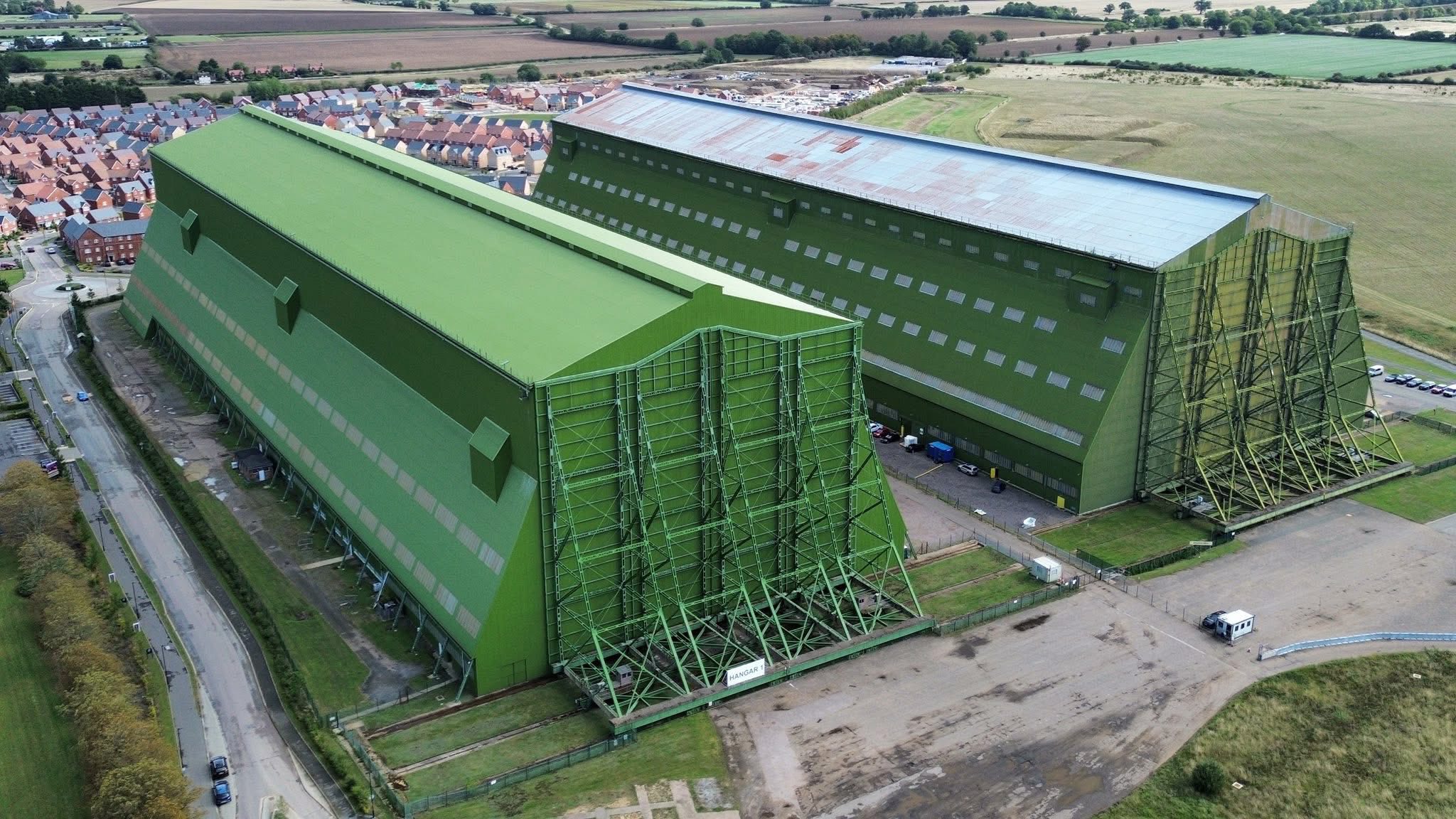
Sourced from the internet – I wish I could get to this viewpoint!
While I can’t claim that we dedicate our lives to tracking down and visiting these monumental evocations of the past, we’ll always try to work one in if the opportunity allows, and here are two sites that sit at opposite ends of the preservation spectrum – one with an (apparently) assured future, the other now under the spectre of demolition.
Let’s start with the upbeat – the airship sheds at Cardington in Bedfordshire. Like many landmarks of their kind, they’re unmissable, hulking on the horizon as one travels the A421 between the A1 and Milton Keynes. At first, one could mistake them for conventional aircraft hangars or distribution sheds, until perspective kicks in and – to paraphrase Father Ted – big and far away must mean very big indeed. The journey from the main road offers teasing glimpses of the pair of them from various angles, until one is eventually driving through the housing estate that sits on the airfield they used to serve and they loom increasingly large above the houses that surround them on two sides. Fortunately, their active usage means that road access is straightforward, certainly at weekends, allowing one to park and walk right up to the sheds, craning the neck to take in the massive height of their doors. It’s not until you stand alongside the wheels on which the doors roll apart, then step back to see how small those wheels are in proportion to the doors themselves, than you really get a sense of scale, magnified over the several minutes it takes to walk from one end to the other.
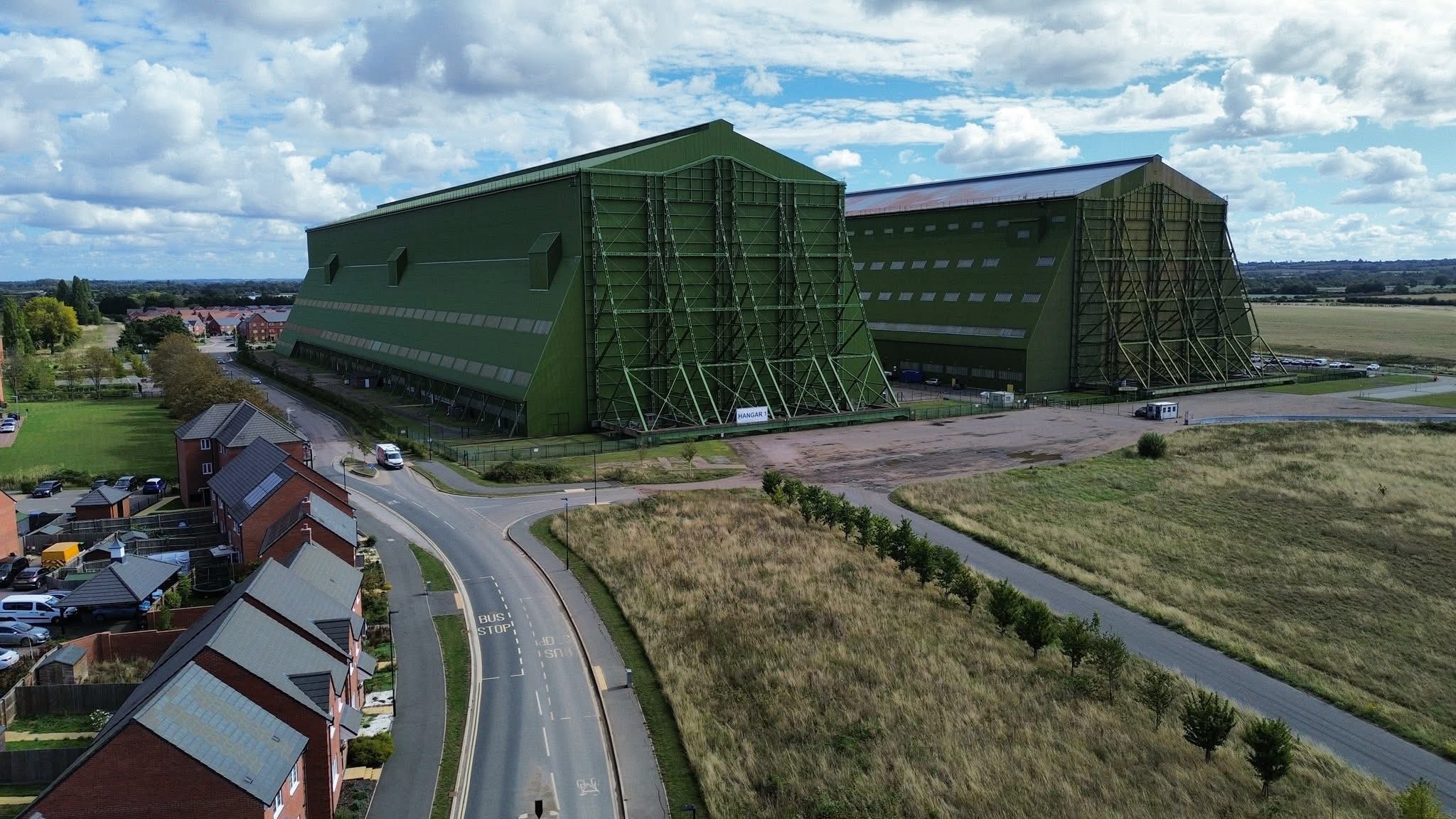
Again – an image from the internet
Their story is as fascinating as the sheds themselves, and is described in full on the Airship Heritage Trust site Cardington – Airship Heritage Trust. The first shed, built during the First World War to compete with the threat posed by the German Zeppelins, was the biggest of its kind in Britain at the time, allowing for two ships to be constructed within its cavernous space. It produced its first airship just five days before the Armistice in November 1918, and the site was promptly mothballed in the post-War era. Reopened in 1924 to cater for the new Imperial Airship Service, the original shed proved too small for the planned R101 and it was raised and lengthened, then by 1928 joined by a second shed moved from Pulham to house R100. By 1930, however, the fatal loss of the R101 led to the dismantling of R100 and threatened the site as a whole, until both sheds were turned over to aircraft storage and the surrounding land reconfigured to a conventional airfield.
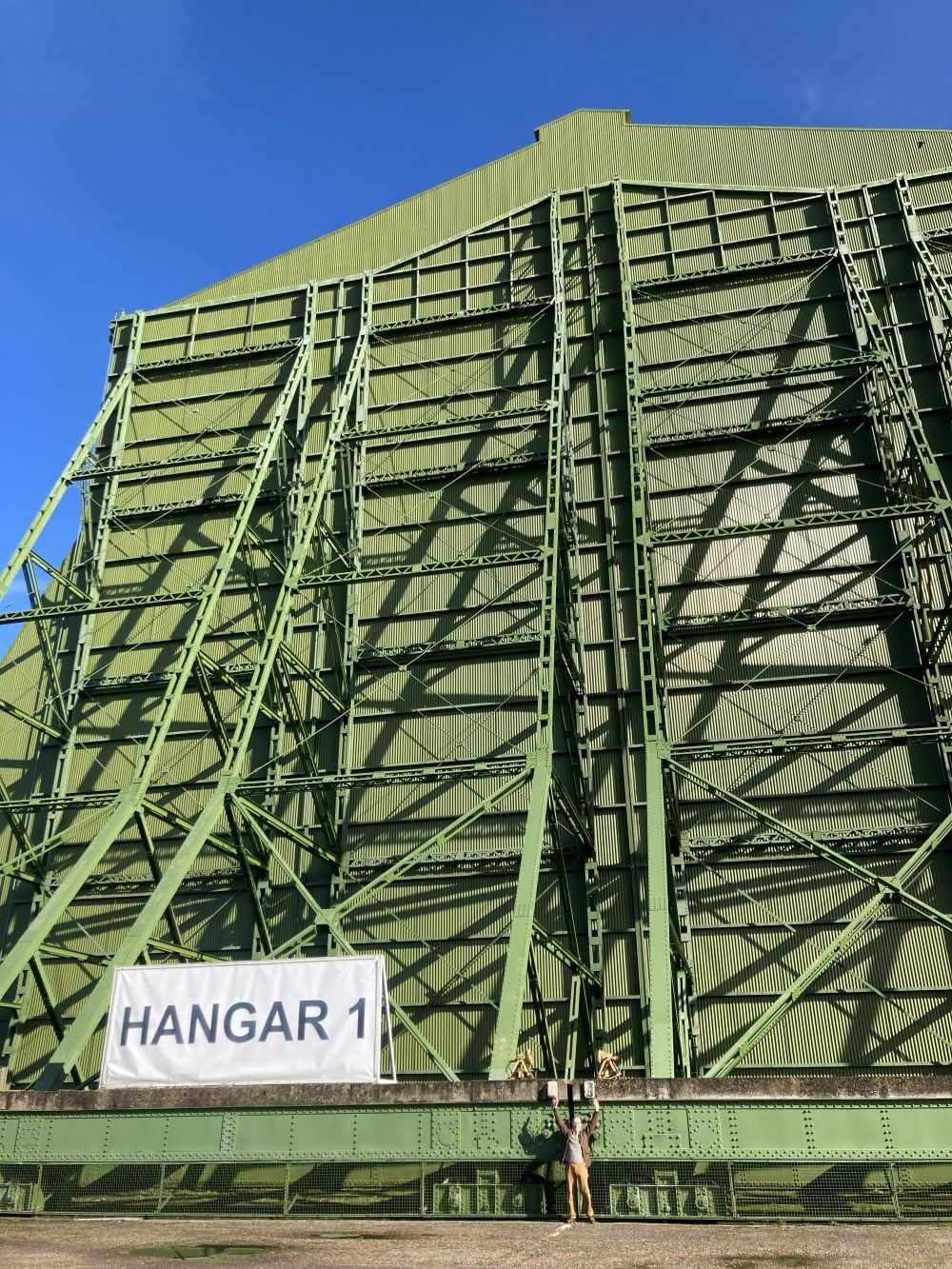
Our own pictures, with your author for scale…
Cardington’s renaissance as a base for ‘lighter than air’ craft came in 1936 when its hangars and gas handling facilities made it the natural home for the anti-aircraft barrage balloon development and training vital for the coming War, turning it into an RAF station proper. This also required the massive sheds to be camouflaged. In all, nearly 300,000 personnel of various balloon-related trades were trained there in the course of the Second World War. A secondary role as a demobilisation centre for those leaving the Armed Forces, and a screening centre for post-War National Servicemen occupied the Station’s administrative buildings, while the balloon unit remained active until 1966. Even then, the specialist gas handling facilities meant that elements of the site remained in RAF hands until the 1980s.
The sheds themselves became available for lease, Shed 2 becoming the home of the Home Office’s Fire Research Station and later the Building Research Establishment, on the basis that entire buildings up to thirteen storeys could be constructed and tested within its controlled environment without interference from the weather. In Shed 1 provided a home for the Goodyear airship, before being leased to Airship Industries, and until 2017 remained in use for ‘lighter than air’ aviation, marking its 80th anniversary in 1997 with a world record for the largest number of balloons ever inflated indoors. It then joined Shed 2 as a filming location for Warner Brothers, the role which the now refurbished sheds continue to perform.
With the surrounding technical and administrative buildings swept away for housing development, these two leviathans stand as remarkable survivors of a relatively fleeting era in air transport.
And in the next instalment, we’ll look at a less happy ending…