 Continuing our dive into industrial architecture of the Twentieth Century, we move from survivors, to a very different site where it’s a definite case of visit quick before they’re gone. Just outside Nottingham, alongside the M1, sits Ratcliffe on Soar power station, until recently the UK’s last coal fired facility. Commissioned in 1968, it’s a perfect example of a dedicated post-War power station, sitting isolated in the countryside, alongside the railway line essential to coal deliveries, with the industrial River Trent beyond.
Construction began in 1963, and it began generating power on 31 January 1968, operating constantly until its closure on 30 September 2024, bringing to an end 142 years of coal-fired power in Britain. Until 2015, it was fed from Nottinghamshire’s own coal mines, consuming 65% of their output in 1981. Even as late as January 2024, all four of its generating units were run together in response to high demand from cold weather.
Whilst no-one would seek to perpetuate a legacy form of power generation, it now seems likely that the cooling towers that once formed such a striking part of the landscape, both at Ratcliffe and elsewhere, will soon be consigned to memory. The 20th Century Society have been campaigning for a set of towers to be preserved – either through repurposing or as a memorial to an era. In October 2025, the Society’s application for listing for Ratcliffe’s eight towers was turned down, and approval was given for demolition of the towers and all other buildings on the site. Unless a renewed campaign can be mounted, demolition of the ancillary buildings is expected to start from June 2026, with the towers themselves and main boiler chimney likely to come down between 2029 and 2030.
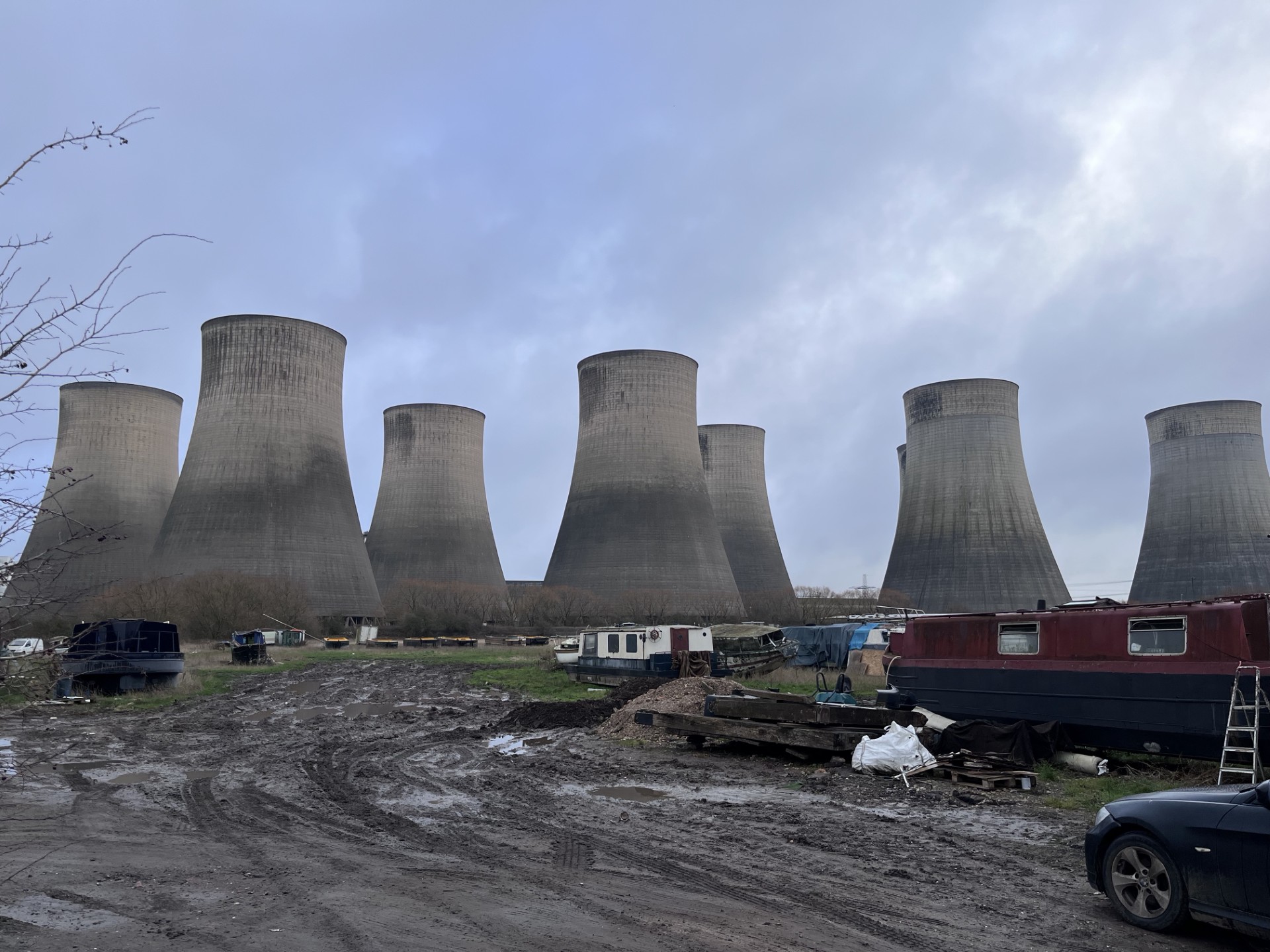
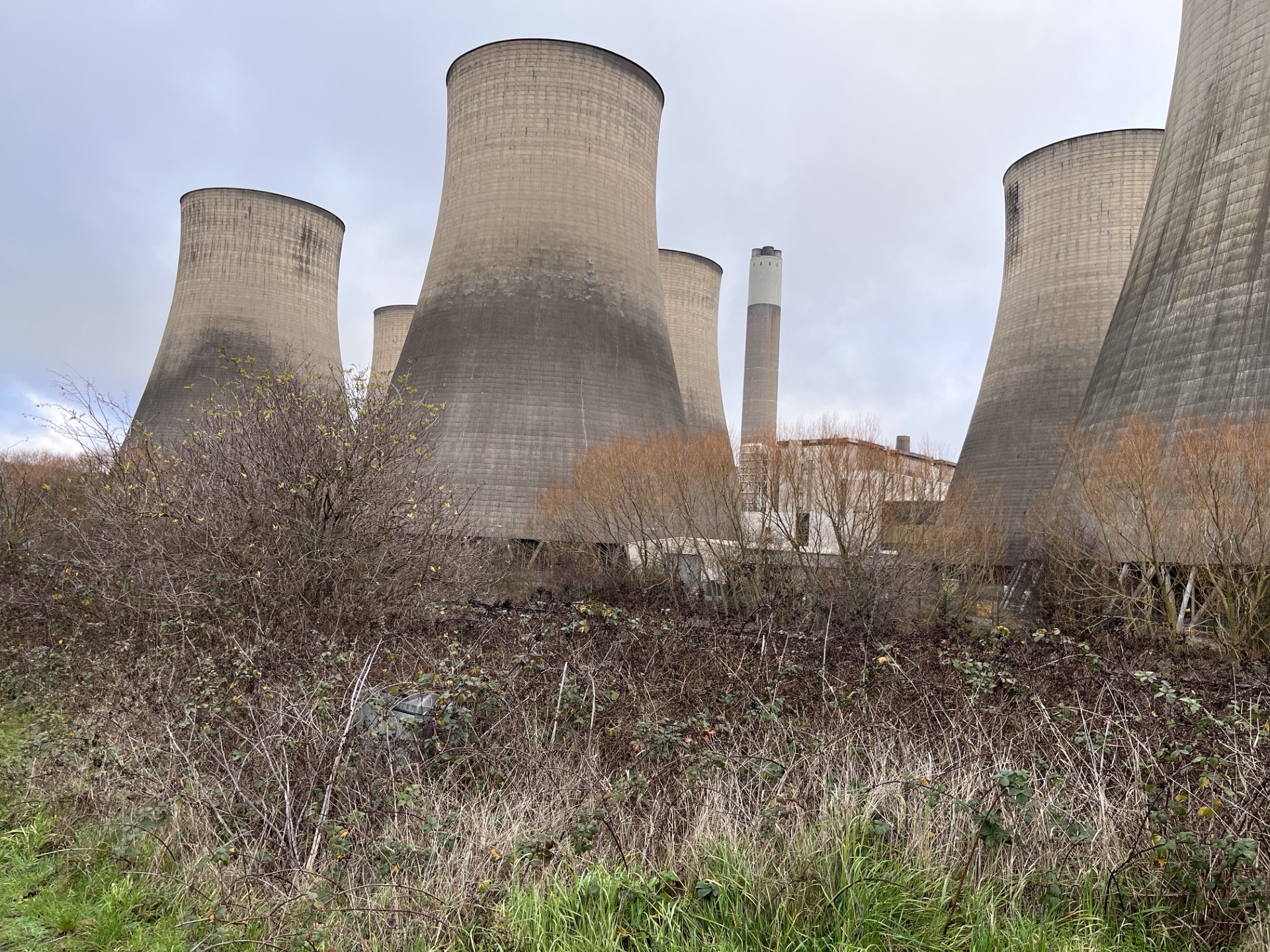 We’ve often seen and admired them in the distance, but with looming disappearance in mind, we took advantage of a recent trip to Sheffield with time in hand to dive off the M1 and take a closer look at these ghosts of a former industrial age. Fortunately, a friend who lives in the area had equipped us with the gen we needed to get in close. Our first vantage point was from the nearby marina, usually handy for a coffee stop, but at this time of the year, atmospherically providing a deserted foreground of canal barges beached on a muddy landscape. From there we headed to East Midlands Parkway railway station where the pick up and drop off parking area gave us enough time to cross to the far platform, taking us within just tens of yards of the foot of the towers themselves.
It’s hard to put their brutalist majesty into words. I can’t claim for a minute to understand how cooling towers work (despite a bit of last-minute googling), but that’s the magic of them. The framework beneath the outer skirt gives the impression of holding up the vast complex curve that stretches up from it, as if acres of concrete were somehow suspended weightlessly on a collection of lolly sticks. The effect at Ratcliffe is magnified by the proximity of eight towers ranked close together, with each gap filled by the glimpse of the one behind. Sixty years on from their construction, they don’t seem to have aged like the buildings around them and their uniquely fit for purpose design gives them a timelessness that other industrial architecture lacks. Amateur photographs don’t do justice, though of course we did our best to capture what we could simply to have our own record.
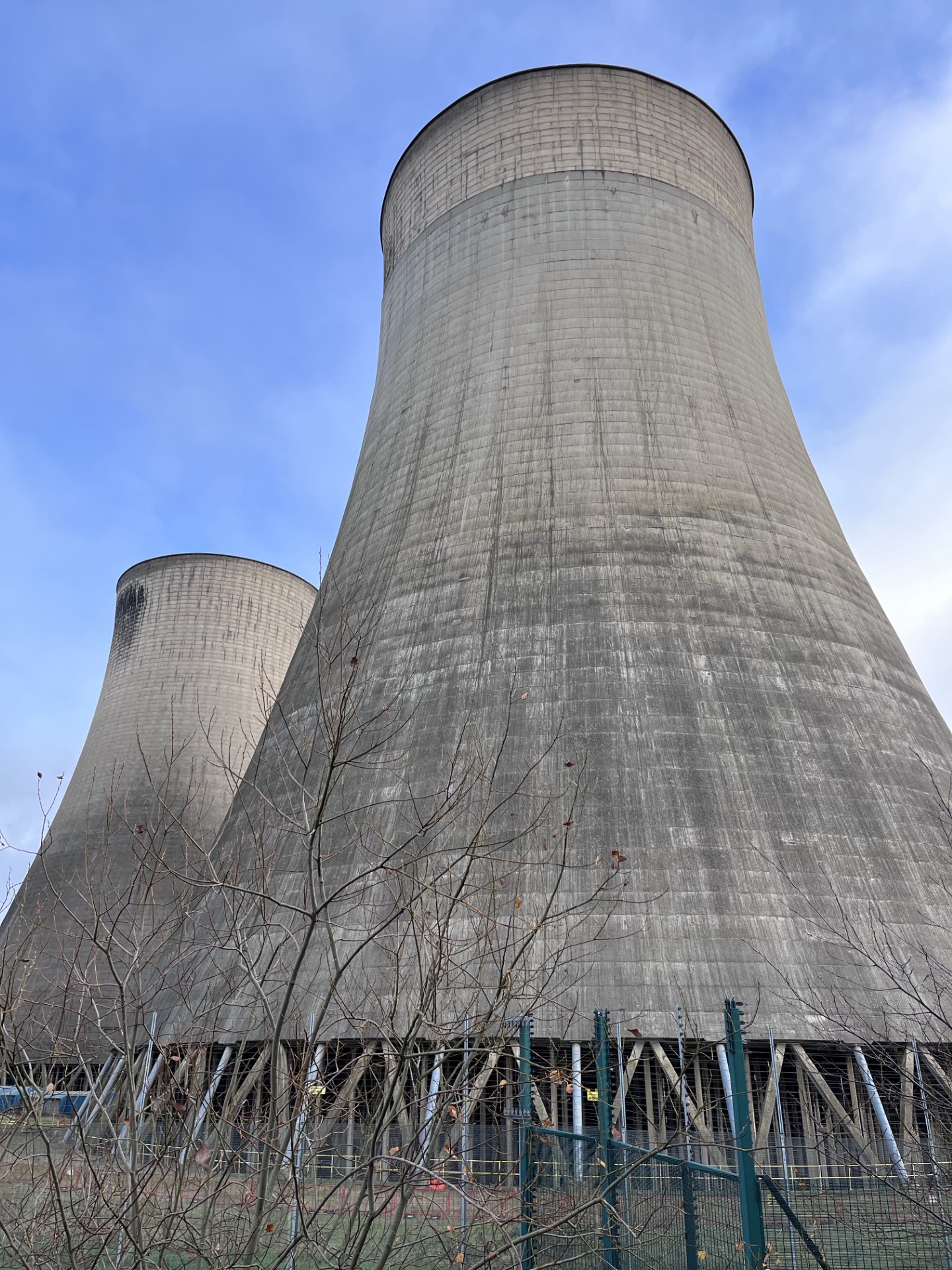 We’ll be looking out for an opportunity to visit within the site itself, with the aim of being able to stand inside and gaze upwards at the inner surface of the walls. It’s also tempting to join what I’m sure will be huge crowds to witness their eventual demise, if only to say we were there at the last to say farewell. Let’s hope that, in the interim, something or someone intercedes to rescue at least one of them so that future generations can look in wonder at these giants of a bygone industrial age.
If Twentieth Century architecture is your thing, I’d strongly recommend joining The Twentieth Century Society, dedicated to studying, promoting and campaigning for significant buildings of all types. From its genesis as the Thirties Society, formed in the wake of the overnight demolition of the Firestone Factory in West London, hours ahead of a preservation order coming into effect, the Society has expanded its remit to embrace the entirety of the century and its buildings. With a regular journal, guided tours and on-line updates, it’s an education, especially for those of us with no specialist architectural knowledge but a clear idea of what floats our building boat.